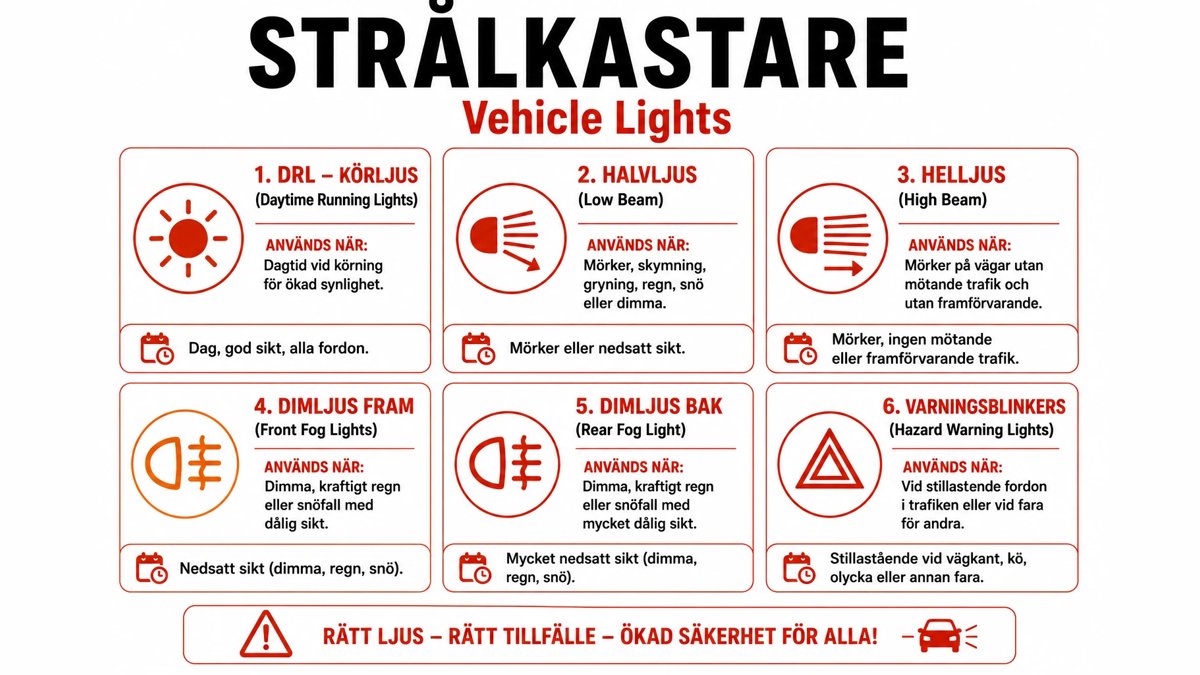
Short answer: In Swedish daylight a car must use dipped beams or another permitted front light, such as daytime running lamps, front fog lamps or reduced-power dipped beams, but not together with dipped beams. In darkness, dawn, dusk and poor weather, dipped beams and rear and side lamps need to be on.
Know what the front lights are doing
In Swedish daylight, a car must use dipped beams or another permitted type of front light. Permitted alternatives include daytime running lamps, front fog lamps and reduced-power dipped beams. Dipped beams and these alternative lights must not be used together. The control in your car may select a mode automatically, but the driver still needs to know what is actually on.
Imagine leaving a bright car park onto a road. The dashboard may show a light symbol, yet that symbol alone may not tell you whether rear lamps are lit. Learn the symbols in your own vehicle before you need them. During supervised practice, check the lights from outside the car while another person operates the controls.
Think of lighting as two tasks: see the road and make your vehicle visible. Daytime running lamps can make the front easy to notice in daylight. They do not replace the lighting needed when the light fades or weather reduces visibility. A good habit is to check both front and rear, not just the road immediately ahead.
Change lighting as daylight fades
At dawn, dusk or in darkness, use dipped or main beam as appropriate. Main beam can illuminate more of an unlit road, but it must not dazzle other road users. Dip the lights when an oncoming driver or a driver ahead could be blinded. The decision depends on where other vehicles are, not just whether the road has street lamps.
Picture a quiet rural road after sunset. Main beam helps you see farther, but you notice headlights approaching around a bend. Switch to dipped beam in time to protect that driver’s view. After the vehicle passes, assess the road again. Avoid treating the light switch as something you set once for the whole journey.
A learner can practise describing the change without memorising an exact distance. Ask where the other driver first becomes visible and when your light might affect them. The relevant question is whether someone could be dazzled. If you are uncertain which beam is active, check the indicator and the beam pattern before continuing.
Check the rear lamps in poor weather
Some cars allow daytime running lamps at the front while the rear and side lamps remain off in daylight. This can be legal in normal daylight. In darkness, at dawn or dusk, and in poor weather such as rain, fog or snow, the dipped beams and rear and side lamps need to be on. A car that looks visible from the front may still be difficult to see from behind.
Imagine rain beginning during an afternoon drive. Do not assume the automatic setting has already switched on the rear lamps. A sensor may react to light differently from the conditions behind the car. Check your vehicle’s lighting mode and use the control needed for both front and rear visibility.
At a safe place after a lesson, ask someone to stand behind the parked car while you change between modes. Record which setting lights the tail lamps. This simple observation is more reliable than guessing from a dashboard symbol. The aim is to know how your specific car behaves before the weather changes on a busy road.
Practise with explanations
Körkort Hero offers 1,700+ practice questions in Trafikverket exam style, with explanations, and works fully offline without ads.
Avoid dazzling while remaining visible
Main beam is useful only while it helps you see without harming another person’s view. Watch for approaching traffic, vehicles ahead and road users whose eyes could be affected. If an oncoming car dips its lights, check your own setting. Dazzle can hide a pedestrian or make the other driver misjudge the road.
Dipped beams also need to work correctly. Before a journey, notice whether one lamp is out and whether the light pattern looks unusual. If you carry a heavy load, check the vehicle instructions for adjusting the beam. The practical goal is a visible car with light directed at the road rather than into other road users’ eyes.
Do not solve poor visibility by leaving main beam on near other traffic. Instead, use suitable lights and reduce speed so you can respond to what you can see. A foggy road may shorten your view even when your lamps are working. Lighting and speed are separate decisions that need to support each other.
Study lights through situations
A useful theory question asks you to match conditions to lighting. Start with the time and weather: clear daylight, dusk, darkness, rain or fog. Then ask what the front lights show, what the rear lamps show and whether another person could be dazzled. This is clearer than memorising a list of lamp names alone.
Compare two photographs of the same car: one in bright daylight and one in rain. Its daytime running lamps may be suitable in the first scene, but the second scene requires you to check that the rear and side lights are also on. Describe what has changed, rather than assuming the car’s automatic mode has handled it.
Finally, learn the switches in the car you practise in. Name the dipped beam, main beam and daytime setting, and check the rear lamps with help. The theory rule becomes easier when you can connect each name to a visible result. If the dashboard is unfamiliar, ask your instructor before driving in poor light.
Frequently asked questions
Do I need dipped beams in the daytime in Sweden?
In daylight you must use dipped beams or another permitted front light, such as daytime running lamps, front fog lamps or reduced-power dipped beams. These alternatives must not be used together with dipped beams.
Are daytime running lamps enough in rain or fog?
Not on their own. In darkness, at dawn or dusk, and in poor weather such as rain, fog or snow, the dipped beams and the rear and side lamps need to be on.
When should I switch from main beam to dipped beam?
Dip your lights when an oncoming driver or a driver ahead could be dazzled. Main beam is useful only while it helps you see without harming another person’s view, so reassess after each vehicle passes.