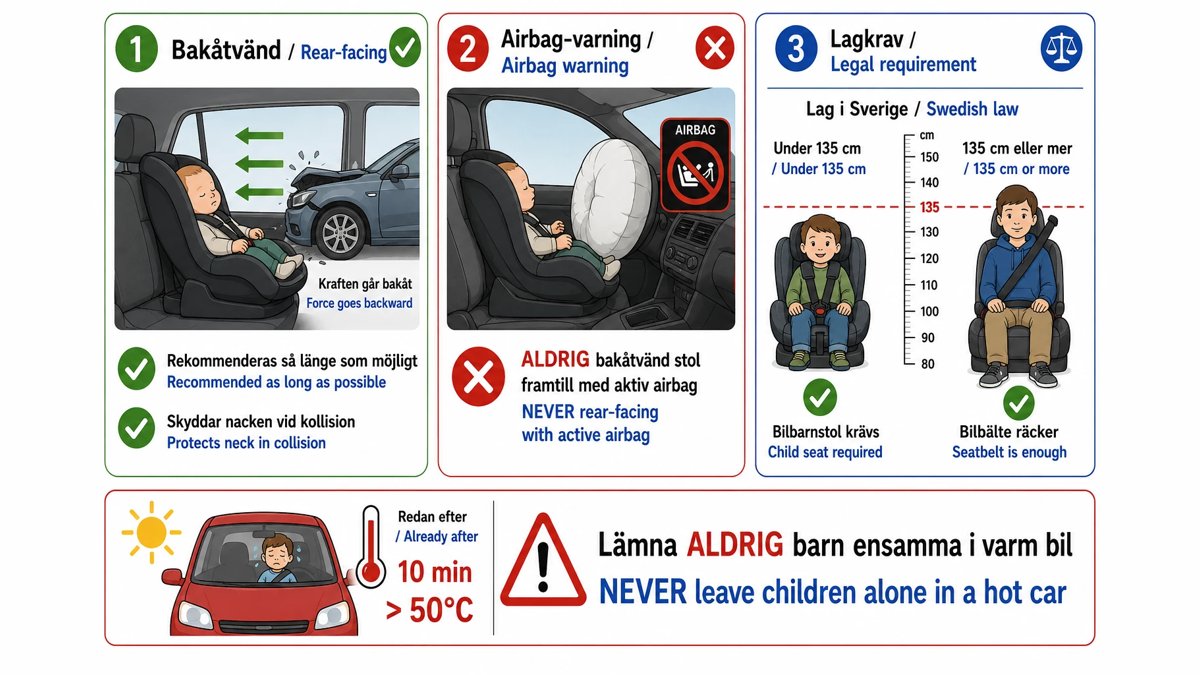
Short answer: A child shorter than 135 cm must use a suitable special restraint in a car in Sweden, such as an infant carrier, child seat, booster seat or booster cushion. The rule depends on height, not age. Never place a child in a restraint on a seat with an active airbag.
Start with the child’s height
In Sweden, a child shorter than 135 cm must use a suitable special restraint in a car. Depending on the child, this may be an infant carrier, child seat, booster seat or booster cushion. The threshold concerns height, not simply the child’s age. Check the child and the equipment before deciding that an ordinary seat belt is enough.
Imagine collecting a friend’s child for a short drive. The journey length does not tell you which restraint fits. Ask the child’s height and check what equipment is available. If the correct restraint is missing, arrange one before the trip. A familiar route can still involve sudden braking, so a quick journey is not a reason to guess.
The device must suit the child and the car. Follow its instructions for the child’s size, the seating position and the belt or mounting system. A booster that fits one child may not fit another. When studying for the theory test, remember the legal height rule, then apply it to the specific child shown in a question.
Use a belted place and check the belt
People travelling in a car must use a place with a seat belt when one is available and use that belt. Children shorter than 135 cm need their appropriate child restraint instead of or together with the belt, depending on the device. The belt should be used as the restraint instructions require. Do not improvise a different route for it.
Before driving, make a visible check. Is each passenger seated in an appropriate place? Is the restraint fixed as instructed? Is the belt fastened and lying correctly? A child may unfasten the belt after the car starts, so pay attention if a warning appears or a passenger says something is wrong.
Suppose the back seat contains bags that make a proper seat difficult to use. Move the bags and secure the load before placing the child there. A seat belt is useful only when the person can sit correctly and the restraint is fitted as intended. Taking a moment to arrange the cabin is part of preparing to drive.
Know who must check younger passengers
Transportstyrelsen says the driver or another responsible adult, such as designated staff or a group leader, must ensure passengers under 15 use a belt or the required special restraint. In an ordinary family car, the driver should check before moving. Do not assume that a young passenger has fitted everything correctly just because they say they have.
Picture a child climbing into a car after school. They may be eager to leave and pull the belt across too quickly. Ask them to pause while you check the fastening and the position of the restraint. Explain the check in simple words, then repeat it at every stop where the child gets out and back in.
For theory revision, separate the child’s height from this responsibility rule. Height determines whether a special restraint is required; the under-15 rule concerns who must make sure the passenger uses the belt or restraint. A test question may mention both facts. Identify which one it is asking about before selecting an answer.
Practise with explanations
Körkort Hero offers 1,700+ practice questions in Trafikverket exam style, with explanations, and works fully offline without ads.
Keep children away from an active airbag
Do not place a child in a child restraint on a passenger seat with an active airbag. The force of an airbag can injure a child close to it. If you plan to use the front seat for a child, check the vehicle and restraint instructions first and ensure the airbag arrangement is suitable. If uncertain, choose another suitable seating position.
Consider a rear-facing child seat that fits into the front passenger place. Its position alone does not make the trip safe: the passenger airbag must be checked. Ask the car owner how the airbag is controlled and how its status is shown. Never assume a dashboard symbol means it is off without understanding the vehicle instructions.
A change of car requires a fresh check. A seat installed correctly in one vehicle may need a different arrangement in another. This matters when using a borrowed car or a car-share vehicle. Read the instructions for both the restraint and the vehicle, and leave enough time to install the seat properly.
Make the preparation repeatable
A practical routine has four steps: check the child’s height, choose a fitting restraint, install it according to its instructions and confirm the belt and airbag situation. Then check that the child is seated correctly before the car moves. Repeating the same sequence helps when you are tired or in a hurry.
In a theory image, look beyond the obvious presence of a child seat. Is it the right type for the child? Is it placed where an active airbag could be a problem? Are belts being used? The rule is about suitable protection, not simply having a seat somewhere in the car.
During supervised driving, discuss a realistic family trip with your instructor. Describe who rides where and what you would check before departure. If an answer depends on a particular vehicle or restraint, consult its instructions rather than making up a universal rule. This keeps the legal height threshold clear while respecting the practical details.
Frequently asked questions
Until what height must a child use a car seat in Sweden?
A child shorter than 135 cm must use a suitable special restraint in a car. The threshold concerns the child’s height rather than age, so check how tall the child is before deciding an ordinary seat belt is enough.
Can a child sit in the front seat with an airbag?
A child in a child restraint must not be placed on a passenger seat with an active airbag, because the force of an airbag can injure a child. If you are uncertain, choose another suitable seating position.
Who is responsible for making sure young passengers wear a belt?
According to Transportstyrelsen, the driver or another responsible adult, such as designated staff or a group leader, must ensure passengers under 15 use a belt or the required special restraint.