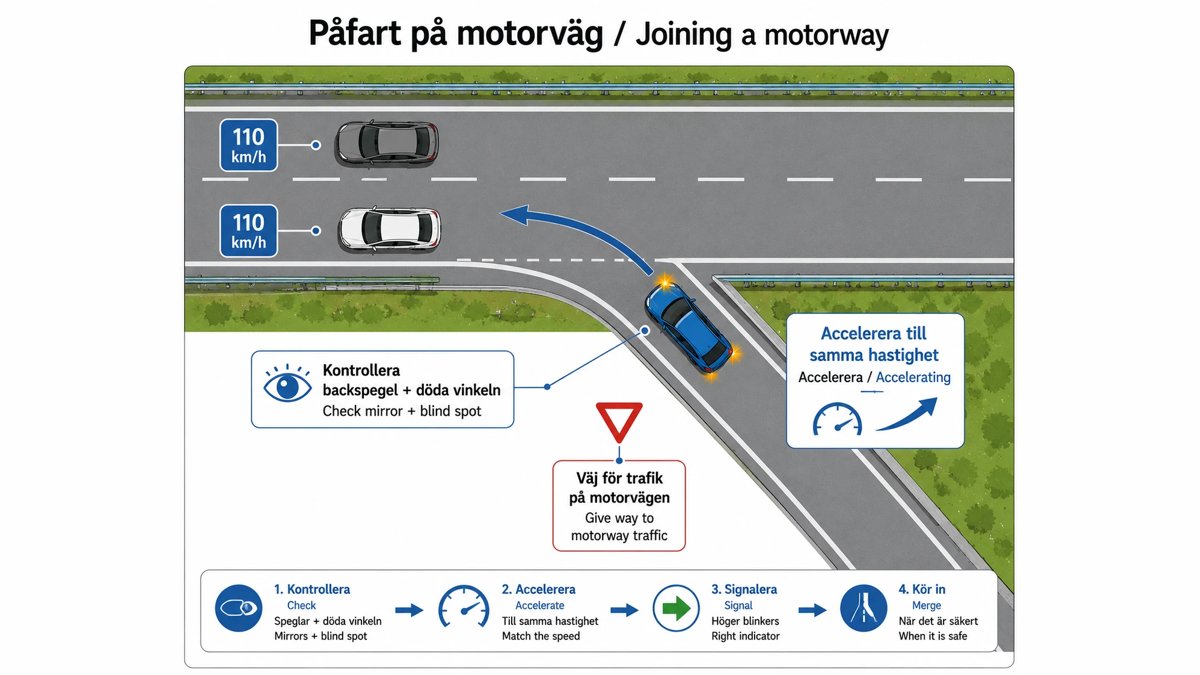
Short answer: On a Swedish motorway, join and leave only by the designated entrances and exits, and never reverse or turn around. Use the acceleration lane where one exists, plan lane changes as separate manoeuvres, and if you miss your exit, continue to a later one and find a lawful route back.
Know what motorway status changes
A motorway, or motorväg, has specific restrictions on access and movement. Entry and exit use the designated entrances and exits. Reversing and turning around are prohibited. You cannot use the central dividing area or a connecting route across it to correct a mistake or shorten your journey.
Motorway access is for motor vehicles, with or without a trailer, designed and legally permitted to travel at least 40 km/h. Class I mopeds are excluded. This access threshold is not an instruction to maintain that speed when congestion or another hazard requires slower travel.
For study, distinguish the type of road from its appearance. A broad road with several lanes does not by itself tell you every applicable rule. Watch the signs establishing the road’s status and the instructions for that particular stretch. Before a first motorway lesson, discuss both the planned entrance and a later exit with your instructor.
Prepare to join before the lanes meet
Joining is easier to understand when you separate preparation from the final movement. Observe the traffic on the main carriageway, look at the available entrance layout and plan where your vehicle could fit. Keep checking the road ahead on the entrance as well as traffic beside you.
Where an acceleration lane is provided, use it to adapt your speed and prepare a safe entry. Avoid fixing your attention on one vehicle for so long that you miss changes ahead. The useful information includes the size of gaps, the movement of surrounding vehicles and how much entrance lane remains.
Practise this with an instructor rather than trying to learn a complicated merge from a slogan. Discuss what you would do if the first gap were unsuitable, if a vehicle changed lanes beside the entrance or if traffic was moving slowly. The objective is to make decisions from the actual conditions, with enough observation to change your plan.
Plan lane changes as separate manoeuvres
At motorway speeds, information can become outdated while you are considering a move. Keep checking rather than deciding from one mirror glance. A vehicle that looked distant may approach quickly, and another vehicle may begin changing lanes at the same time.
Before a lane change, establish why you need it and whether the available space suits the manoeuvre. Communicate your intention and check the relevant blind spot. Then continue monitoring the space you intend to use. A signal helps other drivers understand your plan, but it does not confirm that they have seen you.
If you feel pressure from a vehicle behind, keep your decisions deliberate. Do not make a sudden move into a space you have not assessed. During lessons, discuss how your position affects visibility and how early preparation can reduce unnecessary lane changes. A calm journey can involve fewer manoeuvres because you anticipated the route and traffic sooner.
Practise with explanations
Körkort Hero offers 1,700+ practice questions in Trafikverket exam style, with explanations, and works fully offline without ads.
Prepare the exit and accept a missed turn
Read destination signs early enough to identify your exit and position for it safely. As the exit approaches, keep monitoring surrounding traffic rather than staring only at the sign or navigation display. Confirm the road you are taking and be prepared for a different layout after leaving the motorway.
If you miss the exit, continue to a later suitable exit and find a lawful route back. Do not reverse, turn around or cross the dividing area. A navigation app can calculate a new route; it cannot make a prohibited correction acceptable.
Use this as a practice scenario before it happens. Ask yourself what you would say to a passenger who urges you to take an exit at the last moment. A simple response is enough: you will continue and adjust the route. Planning that response removes the feeling that every direction must be followed immediately, regardless of the traffic situation.
Know the difference between a planned stop and a fault
Normal stopping and parking on a motorway are restricted to designated parking or rest areas, apart from the specific provision for scheduled buses at designated stops. A shoulder is not an ordinary place to stop for a call, a route discussion or a passenger’s convenience.
A breakdown creates a different problem from choosing to take a break. Before travelling, learn the car’s warning indicators and discuss a breakdown procedure with your instructor. Consider where you could move if the car remained controllable and how you would seek help without exposing yourself to passing traffic.
For theory revision, work through a full journey: identify motorway status, assess the entrance, observe surrounding lanes, prepare the exit and choose a suitable rest area if needed. Then add an unexpected event, such as missing the exit. Explain the next safe action. This gives motorway knowledge a practical structure instead of leaving you with disconnected prohibitions.
Frequently asked questions
Can I turn around on a motorway in Sweden if I miss my exit?
No. Reversing and turning around are prohibited on a motorway, and you cannot use the central dividing area to correct a mistake. Continue to a later suitable exit and find a lawful route back.
What vehicles are allowed on a Swedish motorway?
Motorway access is for motor vehicles, with or without a trailer, designed and legally permitted to travel at least 40 km/h. Class I mopeds are excluded. The threshold does not mean you must keep that speed when traffic or hazards require slower travel.
Can I stop on the hard shoulder of a Swedish motorway for a phone call?
No. Normal stopping and parking on a motorway are restricted to designated parking or rest areas, apart from scheduled buses at designated stops. A shoulder is not an ordinary place to stop for a call or a route discussion.