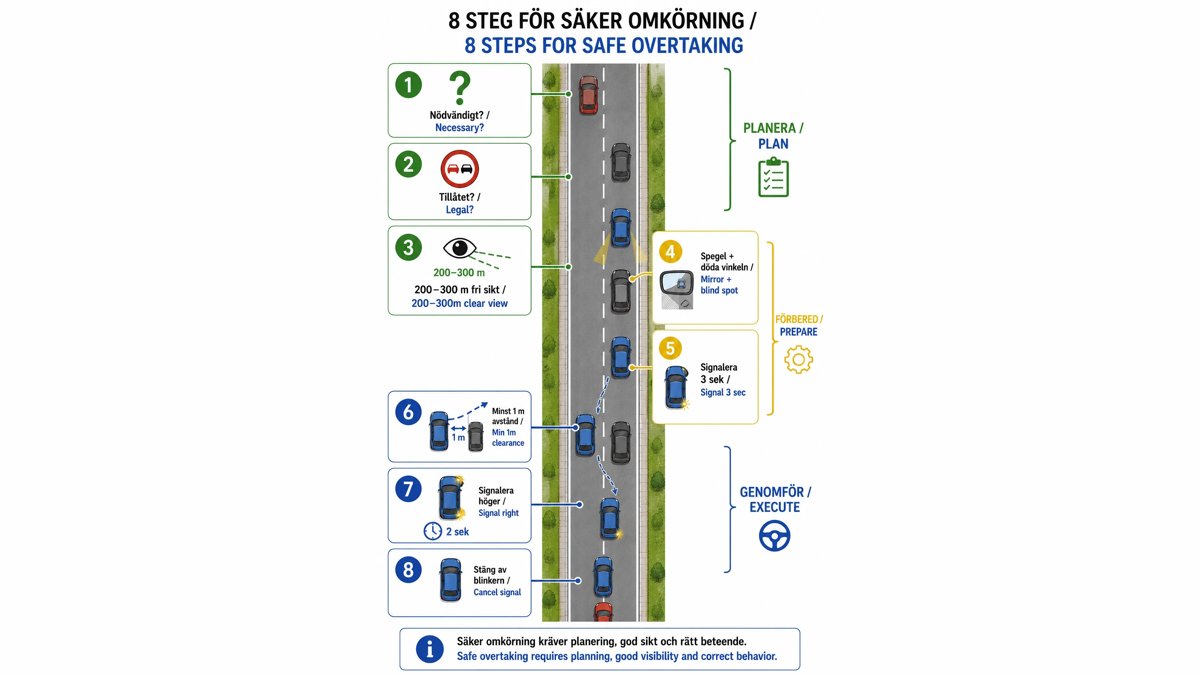
Short answer: In Sweden, overtaking normally takes place on the left, and only when it can be done without danger. The main exception is a vehicle ahead that turns or clearly prepares to turn left, which you pass on the right. Do not overtake just before or on uncontrolled crossings.
Start with the left-side rule
In Sweden, overtaking normally takes place on the left. That is a starting rule, not a reason to move left as soon as the car ahead slows. First decide whether passing is necessary and possible. On a narrow country road, waiting behind a slow vehicle may be the safest decision until the view opens.
The rule has exceptions, so avoid a simple claim that every vehicle passing on the right breaks the law. Lane arrangements and the movement of the vehicle ahead matter. For a theory question, identify what each vehicle is doing before you choose an answer based only on where one car appears beside another.
Imagine approaching a vehicle travelling below the speed limit. The lower speed of that vehicle does not create a safe overtaking opportunity. Look farther ahead for bends, approaching traffic, junctions and places where someone may enter the road. The decision begins with the scene, not with impatience.
Check the whole passing space
You may overtake only when it can happen without danger. If a driver behind has already started to overtake, you must not begin your own overtake. Check behind you before moving out. A mirror glance taken several seconds earlier is not enough when the positions of vehicles may have changed.
On a road where your passing move uses space for oncoming traffic, the lane must be free for a long enough stretch. You also need room to return to the right without danger to others. If you cannot see far enough beyond a bend or crest, do not guess that the opposite lane is empty.
Leave a safe sideways distance from the vehicle you pass. This matters especially when passing a cyclist or another road user who may need room to avoid an obstacle. After overtaking on the left, return right when it is safe and does not cause difficulty. Do not cut sharply in front of the other vehicle.
Understand the right-side exception
A clear exception applies when the vehicle ahead turns left or clearly prepares to turn left: overtaking then takes place on the right. This does not mean you must squeeze through a narrow gap. You still need to assess the available space, people at the side of the road and whether the move can be completed safely.
Picture a car ahead indicating left and positioning for a turn. First check whether its movement is clear, then look at the right side of your own path. A cyclist, pedestrian or parked vehicle may make that space unsuitable. Waiting is possible even when the rule points to passing on the right.
Other lane-specific situations also exist, so a test picture may require more than the basic left-versus-right rule. Read signs, markings, traffic density and destinations. The key question is whether the apparent pass is an overtaking manoeuvre under the circumstances and, if so, which rule applies.
Practise with explanations
Körkort Hero offers 1,700+ practice questions in Trafikverket exam style, with explanations, and works fully offline without ads.
Take extra care near crossings
Do not overtake a vehicle or tram just before or on an uncontrolled pedestrian crossing, an uncontrolled cycle passage or a cycle crossing. A larger vehicle can hide a person approaching the crossing. When you see crossing markings ahead, shift your attention from passing to what may be concealed.
Imagine following a van towards a zebra crossing. You might see the road beyond the van but not a person waiting near its front corner. Moving out to pass would remove the van from your line of travel while creating a new risk for the person. Hold back and reassess after the crossing.
Junctions, railway crossings, bends and crests have additional restrictions and exceptions. Do not turn them into a single rule such as “never pass near any junction.” Study the exact situation and the relevant official rule. If the answer depends on a signal, crossing control or the direction of a turn, identify that detail first.
Turn the rule into a driving routine
Use a fixed sequence while learning: look well ahead, check behind, judge the available passing distance, check alongside, communicate your movement and continue observing. If one part is unclear, stay in your lane. A safe overtake is a complete movement, including the return to your normal position.
During a supervised drive, discuss one opportunity that you chose not to take. Was the view too short, was another driver already passing, or was there a crossing ahead? Naming the reason builds judgement. The ability to reject an unsafe gap is as important as knowing the formal left-side rule.
For revision, compare two drawings with the same slow car ahead. Add a left-turn indication in one drawing and an uncontrolled crossing in the other. Explain how each new detail changes your choice. This makes the rule useful in unfamiliar test images instead of a phrase memorised without context.
Frequently asked questions
Which side do you overtake on in Sweden?
Overtaking normally takes place on the left. The exception is when the vehicle ahead turns left or clearly prepares to turn left, then overtaking takes place on the right, provided you can assess the space and do it safely.
When must I not start to overtake?
Do not overtake if a driver behind you has already started to overtake, or if you cannot see far enough to know the oncoming lane is free for long enough. You also need room to return to the right safely.
Can I overtake near a pedestrian crossing?
No. Do not overtake a vehicle or tram just before or on an uncontrolled pedestrian crossing, an uncontrolled cycle passage or a cycle crossing, because a larger vehicle can hide a person approaching the crossing.