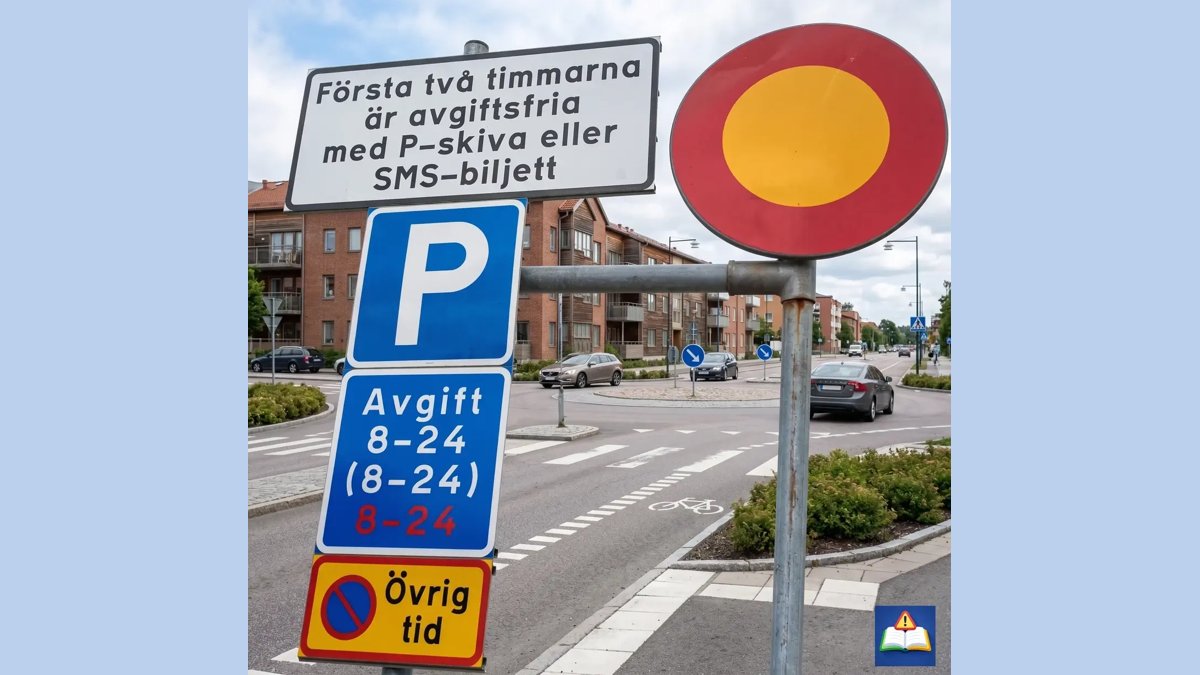
Short answer: In Sweden, parking is not the same as stopping, and a car can count as parked even with the driver inside. You must not stop or park on a pedestrian crossing or within 10 metres before it. Always read the main sign and every additional panel for payment, time limits or parking discs.
Decide whether you are stopping or parking
In Sweden, sitting in the driver’s seat does not automatically mean you are only stopping. A car can be parked while its driver remains inside. The reason the vehicle is stationary matters. Waiting for traffic or avoiding danger is different from choosing somewhere to wait for a friend.
Picking up or setting down passengers and loading or unloading goods are excluded from the definition of parking. However, this does not make them allowed wherever you choose. A restriction on stopping can still prevent you from using that location for a passenger drop-off.
Consider two situations outside a building. In the first, your passenger is immediately getting out. In the second, you sit and wait while the passenger finishes an appointment upstairs. Do not describe both simply as “a quick stop”. Identify what is actually happening, then check whether that activity is permitted in that place.
Check the road before looking for a payment machine
Start with safety and general restrictions. A place can be unsuitable even when there is no parking sign beside it. Transportstyrelsen explains that general stopping and parking prohibitions do not all have individual signs. Local conditions may add further restrictions, normally shown by signs.
You must not stop or park on a pedestrian crossing or within 10 metres before it. At a road junction, the prohibition covers the junction and the area within 10 metres of the nearest edge of the intersecting carriageway. Think about the space another driver needs to see someone approaching.
For a learner, a useful first scan includes crossings, junctions, entrances, cycle facilities and visibility. Do this before becoming focused on an empty space. A payment machine nearby tells you that some parking exists in the area; it does not prove that every piece of kerb nearby is a legal parking place.
Read the full set of conditions
Look at the main parking sign and every relevant additional panel. Establish which area or spaces the signs refer to, which vehicles may use them and whether payment, a time limit or a parking disc is required. Read the arrangement as a whole rather than selecting the part that seems most convenient.
Before leaving the car, be able to answer these practical questions in plain language: Am I allowed to use this space? What must I do now? When must I return? If one answer is unclear, read the signs again or choose a place whose conditions you understand.
For example, a free space is not necessarily an unrestricted space. There may still be a time limit or another condition. Likewise, paying does not give permission to ignore a separate restriction. Build the habit of checking permission first and completing any required payment or registration afterwards.
Practise with explanations
Körkort Hero offers 1,700+ practice questions in Trafikverket exam style, with explanations, and works fully offline without ads.
Check the position of the whole vehicle
A successful parking manoeuvre is more than fitting the car between two other vehicles. Look at where the wheels are, whether another driver can get out and how passengers will open their doors. Your final check should include the space around the vehicle, not only the distance from the kerb.
Do not park in front of a vehicle entrance or in a way that substantially obstructs vehicles entering or leaving a property. Do not park with a wheel outside the marked parking space. These checks are especially useful in small courtyards and busy car parks where an apparently empty area may serve another purpose.
Before opening a door, check for passing cyclists and other traffic. Ask passengers to check too. Then secure the vehicle so it cannot roll. If you are practising on a slope, ask your instructor to explain the correct procedure for the particular car rather than copying a routine without understanding it.
Use a short routine every time
Try a consistent sequence: assess the location, read the conditions, position the vehicle, complete the required parking steps and check before walking away. The sequence is a study aid, not an additional legal rule. It helps prevent an easy parking manoeuvre from distracting you from a restriction.
When studying a parking photograph, describe the scene before choosing an answer. Which direction is traffic travelling? Is the crossing ahead of the car? Where does the side road begin? Is the driver waiting, unloading or responding to traffic? These details may explain why two similar pictures lead to different answers.
Finally, practise choosing another location. If a sign arrangement is unclear or a space leaves poor visibility, continuing to a clearer option is a useful driving decision. Parking should end with confidence that you understand both the location and its conditions, rather than a hope that a short stay will be overlooked.
Frequently asked questions
Is waiting in the car with the engine running parking in Sweden?
It can be. Sitting in the driver’s seat does not automatically mean you are only stopping. Picking up or setting down passengers and loading or unloading goods are excluded from the definition of parking.
How close to a pedestrian crossing can you park in Sweden?
You must not stop or park on a pedestrian crossing or within 10 metres before it. At a junction, the ban covers the junction and the area within 10 metres of the nearest edge of the intersecting carriageway.
Is a free parking space always allowed in Sweden?
Not necessarily. A free space may still have a time limit or another condition. Read the main parking sign and each additional panel to learn who may use the space and whether payment or a parking disc is needed.