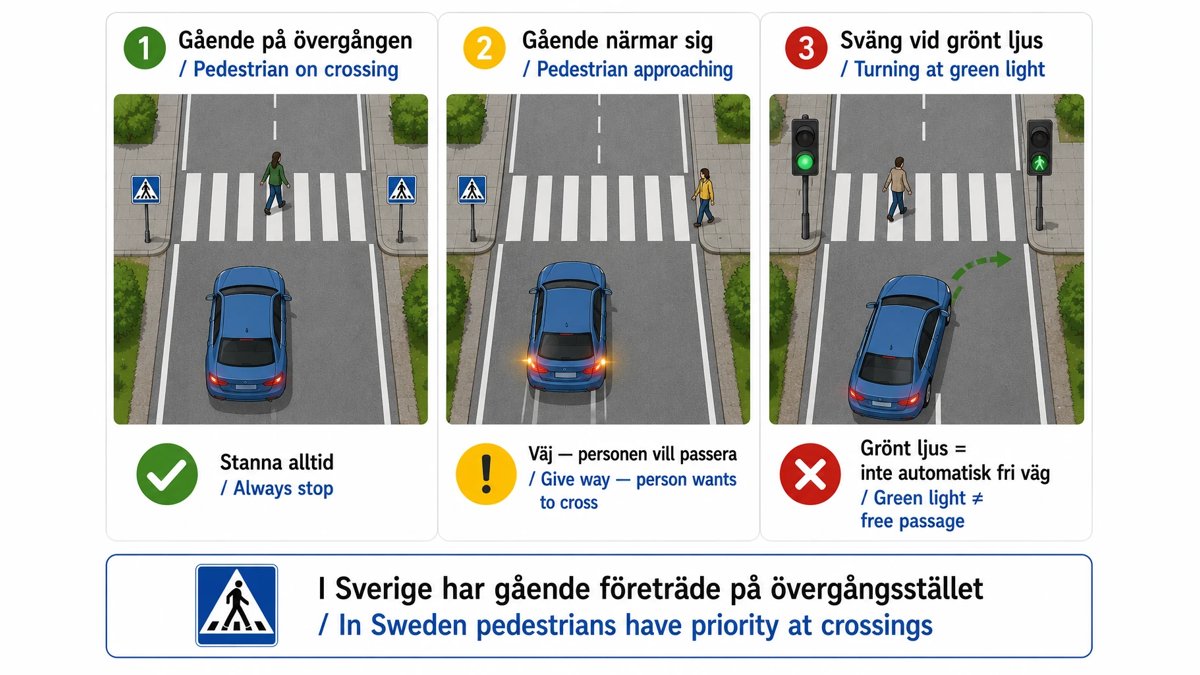
Short answer: At an uncontrolled pedestrian crossing in Sweden, drivers must give way to pedestrians crossing or about to enter, and a person walking a bicycle counts as a pedestrian. A cycle passage and a cycle crossing are different arrangements with different duties, so identify the facility first.
Identify the crossing before deciding who yields
A place where people cross the road can contain several different facilities. A pedestrian crossing may sit next to a route for cycles, and both may cross the same traffic lane. Do not assume that the rules are identical simply because the markings are close together. First identify the facility and the person using it.
Learn three Swedish terms together: övergångsställe means pedestrian crossing, cykelpassage means cycle passage and cykelöverfart means cycle crossing. The last two names look similar, but they describe different arrangements. Recognising that difference is more useful than trying to decide from the presence of a bicycle alone.
When studying a picture, trace each route with your eyes. Where does the pavement lead? Where is the cycle path? Which signs and markings identify the place where each route crosses the carriageway? This short observation stage prevents you from applying the correct rule to the wrong part of the photograph.
Understand people walking and people riding
At an uncontrolled pedestrian crossing, drivers must give way to pedestrians who are crossing or about to enter it. A person walking a bicycle counts as a pedestrian. Pedestrians must also take account of approaching vehicles rather than stepping out without considering the traffic.
A person riding across an uncontrolled pedestrian crossing does not receive the same pedestrian priority simply by using the zebra markings. That distinction does not make it acceptable to continue into a dangerous situation. Keep watching the person and leave yourself room to respond to unexpected movement.
Compare two photographs of the same crossing. In one, a person has dismounted and is pushing a bicycle. In the other, the person remains seated and pedals across. Describe the difference before answering. Then look for any separate cycle facility beside the zebra crossing, because that may introduce another rule you need to consider.
Distinguish a cycle passage from a cycle crossing
At an uncontrolled cycle passage, a cyclist entering from a cycle path generally has a duty to give way when crossing the road. A driver on the road must nevertheless adapt speed so cyclists already on the passage are not endangered. This is not permission to ignore someone who is crossing.
A cycle crossing has both the relevant cycle-crossing sign and road markings. Here drivers must give way to cyclists and class II moped riders who are on it or about to enter it. People entering from the cycle path must still consider the distance and speed of approaching vehicles.
For revision, put examples of the two facilities beside each other. Identify the evidence that tells you which is which, then explain the driver’s duty in each case. Avoid a vague answer such as “bicycles always go first”. The location and the movement matter, and a general slogan cannot replace reading the actual arrangement.
Practise with explanations
Körkort Hero offers 1,700+ practice questions in Trafikverket exam style, with explanations, and works fully offline without ads.
Check again when turning or leaving a roundabout
There is an important turning situation to learn. When you leave a roundabout, or turn at another junction, and then cross an uncontrolled cycle passage, drive slowly and allow cyclists and moped riders who are on it or about to enter it to pass. Do not transfer the straight-ahead situation to this turning movement.
Imagine approaching a side road while a cycle route continues beside your original road. Before turning across that route, look for someone approaching along it. A cyclist can be outside the narrow area you first checked. Recheck as the turn develops rather than relying on one glance made well before it.
Practise this sequence with your instructor at a quiet location. Describe the vehicle’s route and the cycle route separately, then locate their meeting point. This makes the risk easier to understand from both perspectives. Your observation should follow the potential conflict, including the area beside the car and the road you are entering.
Build a crossing routine you can explain
Use the same questions when looking at a real road or a theory-test image. What facility is present? Is the person walking or riding? Are signals controlling movement? Am I continuing straight, turning or leaving a roundabout? What could be hidden by another vehicle? Answering in that order helps separate observation from assumptions.
Plan for the space beyond the crossing too. If traffic is queued after it, consider whether moving forward would leave you blocking someone’s route. Watching only the markings immediately in front of the bonnet can make you miss the larger situation.
For a final self-check, explain why a pedestrian crossing and a cycle crossing are not interchangeable. Then describe how your duties can change when you turn across a cycle passage. If you can identify the facility, describe the movement and explain the risk without guessing, you have a practical method for handling questions about pedestrians and cyclists.
Frequently asked questions
Do drivers have to stop for a cyclist at a zebra crossing in Sweden?
A person riding across an uncontrolled pedestrian crossing does not get pedestrian priority just by using the markings. Someone walking their bicycle counts as a pedestrian. Keep watching and leave room to respond to unexpected movement.
What is the difference between a cycle passage and a cycle crossing in Sweden?
At an uncontrolled cycle passage, a cyclist coming from a cycle path generally must give way. A cycle crossing has its own sign and markings, and drivers must give way to cyclists and class II moped riders on it or about to enter.
What should I do when turning across a cycle passage?
When leaving a roundabout or turning at a junction and crossing an uncontrolled cycle passage, drive slowly and let cyclists and moped riders on it or about to enter pass. Recheck as the turn develops.