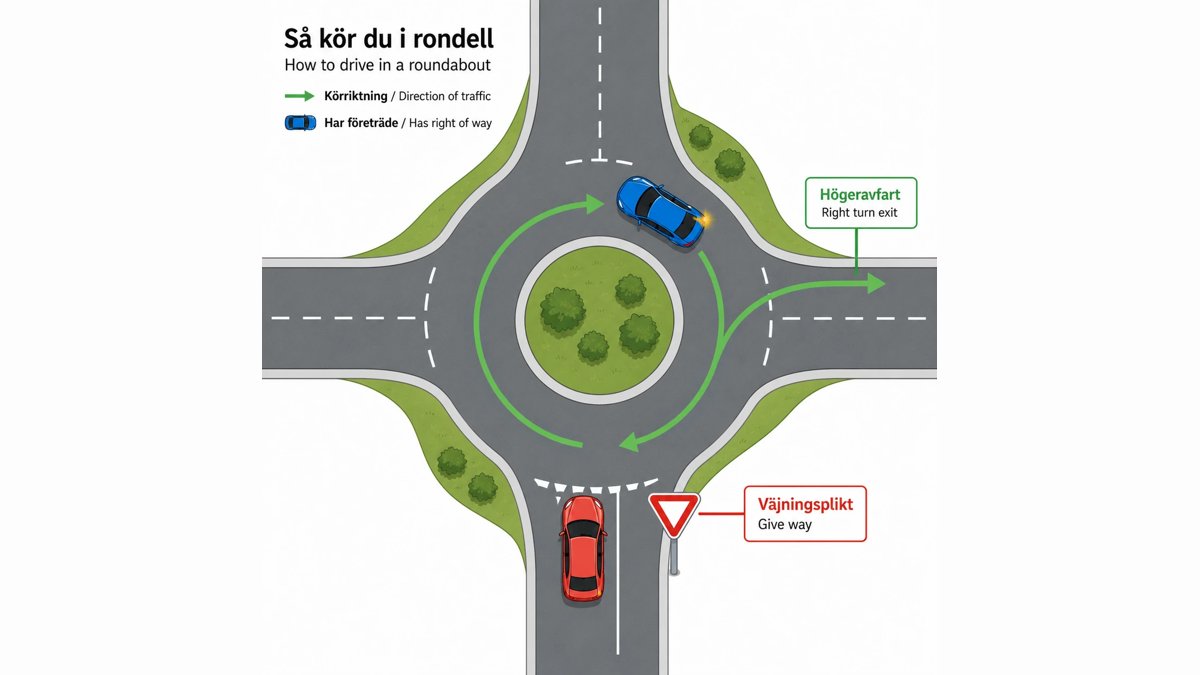
Short answer: In a Swedish roundabout you enter by giving way to vehicles already circulating, and traffic travels anticlockwise around the central island. Choose a lane that suits your route using signs and markings, signal when changing lanes, and signal right when leaving. Entering itself does not require a signal.
Read the approach before choosing a lane
A Swedish roundabout can feel busy because several decisions happen close together. You need to find your exit, understand the lanes and watch vehicles already circulating. Separate these decisions. Read the direction signs first, then look at lane arrows, then assess whether there is a safe opportunity to enter.
Traffic travels anticlockwise around the central island. Drivers entering must give way to vehicles already in the roundabout. Slow down early enough to assess their movement. Stop when necessary, but do not treat every entry as an automatic stop when the way is clear.
For example, imagine approaching a roundabout with a lorry circulating towards your entry. Focus on its actual position and movement rather than guessing its destination. A large vehicle may need more road space than a car. Leave room instead of trying to enter alongside it through a narrow gap.
Choose for your route and follow the markings
Choose a lane suitable for your onward journey and follow the signs and road markings. Avoid memorising a rule that every second exit always means the same lane. Roundabouts differ in shape, number of exits and lane arrangements. The layout in front of you matters more than a diagram you remember.
On a practice drive, ask your instructor to discuss the approach afterwards. Which sign first identified the destination? When did the lane arrow become visible? Was there enough time to position the car smoothly? This turns an uncertain moment into a specific observation you can improve.
If you notice your destination late, avoid making a sudden move across another vehicle. Continue along a permitted route and find a safe way to correct your journey. A navigation instruction does not remove your responsibility to check the road. Missing an exit is easier to manage than creating a conflict beside your car.
Understand entry, lane-change and exit signals
Entering a roundabout does not itself require a signal. Signal when changing lanes or otherwise moving significantly sideways, and signal right when leaving. Keep these actions separate in your mind: joining the circulating road, changing position within it and leaving it are different movements.
A signal communicates an intention. It does not make a lane change safe. Before moving, check mirrors and the relevant blind spot, assess the space beside you and consider whether another vehicle could be hidden. Only change lanes when this can happen without danger or unnecessary obstruction.
Practise describing one journey aloud while looking at a drawing. Say where you enter, where you remain in your lane, where any lane change happens and when you signal to leave. If your explanation contains only “I turn left”, you may be missing the separate decisions inside the roundabout. Clear descriptions help you identify which rule a theory question is testing.
Practise with explanations
Körkort Hero offers 1,700+ practice questions in Trafikverket exam style, with explanations, and works fully offline without ads.
Prepare the exit before you reach it
An exit needs preparation. If possible, arrange your driving so you are in the right lane when leaving. If you leave from a lane farther left, remember that crossing the outer lane involves a lane change. A vehicle beside you may continue around rather than leave at your exit.
Imagine you are approaching your exit and a car remains just to your right. Do not assume its driver has understood your plan or will create a gap. Keep a safe course and follow the available lane guidance. Discuss alternative routes with your instructor before trying a complicated layout alone.
Continue observing beyond the circulating carriageway. An exit may lead directly towards people walking or cycling. Check what kind of crossing is present and be ready to respond to it. Your task is not finished when you have turned the steering wheel towards the exit; you still need to read the road immediately ahead.
Practise situations rather than exit numbers
For theory study, compare situations that look similar but require different observations. Use one roundabout with a single lane and another with several lanes. Then compare an empty outer lane with one containing a vehicle. Explain which information changes your decision rather than simply naming an exit number.
Useful practice questions include: Who must give way at entry? Does this movement involve a lane change? What does the marking tell me? Who could be beside the car? Where will my right signal become useful to others? Answer each question before checking the explanation.
During supervised driving, repeat a familiar roundabout until you can identify the signs and other road users without rushing. Then try a different layout. The aim is a repeatable process: read the approach, choose a suitable lane, assess entry, observe while circulating and prepare the exit. Knowing that process is more useful than remembering a single route.
Frequently asked questions
Who has right of way in a roundabout in Sweden?
Drivers entering must give way to vehicles already in the roundabout. Slow down early to judge their movement. You stop when necessary, but you do not have to stop automatically when the way is clear.
Do you have to signal when entering a roundabout in Sweden?
Entering a roundabout does not itself require a signal. You signal when changing lanes or moving significantly sideways, and you signal right when leaving. Joining, changing position and leaving are treated as separate movements.
Which lane should I use in a Swedish roundabout?
Pick the lane that suits your onward journey and follow the signs and road markings. Do not rely on a fixed rule for each exit, because roundabouts differ in shape, exits and lane arrangements.