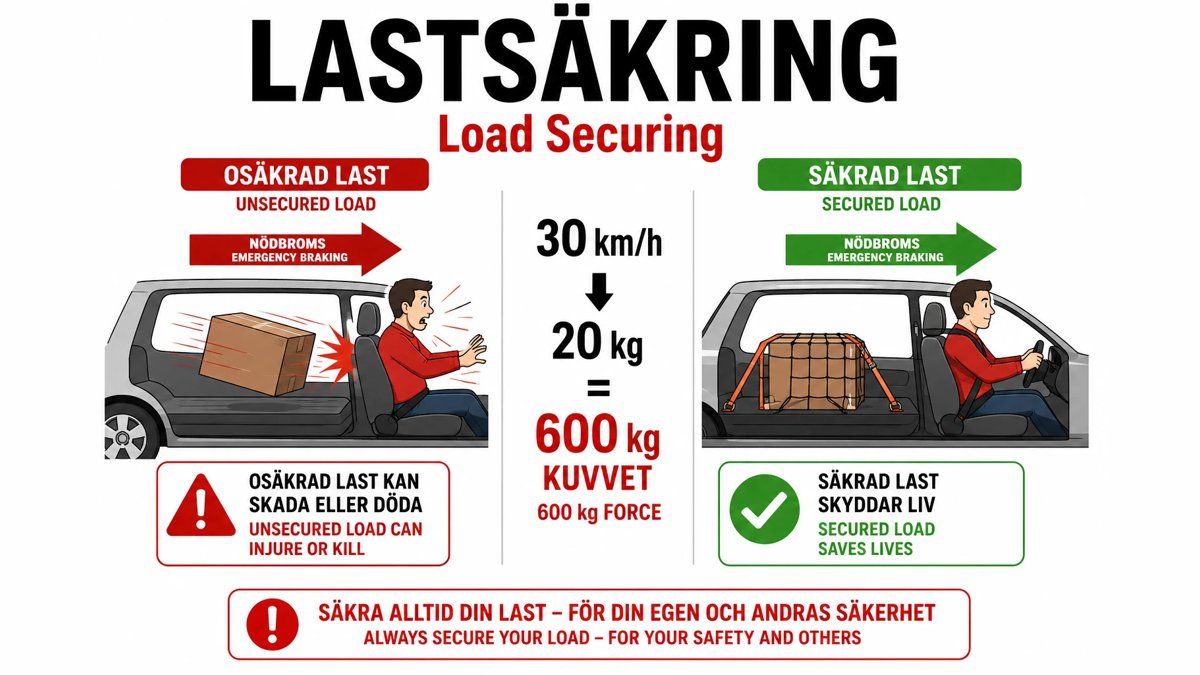
Short answer: Secure every load in a Swedish car so it cannot shift or fall, whether it sits inside the car, in a roof box or on a trailer. Keep heavy items low, never above the backrest, check the roof limit in the car manual before using a roof box, and fasten all trailer cargo.
Why loose luggage matters
A bag on a rear seat can move suddenly when a car brakes. A heavy object may strike a passenger even during an ordinary change of speed. Treat every item you carry as part of the driving task. Before you leave, decide where it can go, how it will be held and whether it could block your view or controls.
Transportstyrelsen advises drivers to secure loads so they cannot shift or fall. This applies to things inside the car as well as items outside it. A closed boot helps contain luggage, but it does not make careless stacking harmless. Imagine a suitcase at the top of a tall pile: what would stop it moving if you brake hard?
Start by asking what the load will do if the vehicle turns, brakes or is struck. Look from the driver seat as well as from outside. If something hides a mirror, covers a lamp or can reach the pedals, change the arrangement before starting. A quick check now is easier than solving a problem while moving.
Pack the passenger compartment and boot
Put heavier items low and position them so they are less likely to move. Transportstyrelsen advises against placing heavy luggage above the backrest even when a cargo net is fitted. If you are moving a television, for example, do not balance it above the rear seats. Use a suitable restraint and keep it from becoming a moving object.
Passengers and luggage need separate space. Do not let a parcel interfere with a seat belt or a child restraint. Close the boot or hatch properly, and check that a large object has not caught the latch. Ask another person to help hold or reposition awkward cargo while the car is stationary; do not adjust it during the journey.
A practical test is to ask whether the item would remain in place after a sharp bend. If the answer is uncertain, fasten it again or choose a different location. The right solution depends on the vehicle and the item. Follow the car manual and the instructions for any straps, cargo barrier or other securing equipment.
Check a roof box before driving
A roof box creates extra carrying space, but the roof has a load limit. Check the car manual before packing. The box itself counts towards the weight on the roof, as do the crossbars and luggage. A box marked with its own capacity does not increase what the vehicle roof can safely carry.
For example, if a family is adding a box for a holiday, first identify the car roof limit and the box instructions. Then consider the weight of the empty equipment before adding bags. If you cannot determine a required limit, stop and check the documents. Guessing from the size of the box is not a reliable method.
Attach the box according to its instructions and confirm that it is closed and locked. Put contents where the box maker recommends and secure them inside if required. Before a long trip, check the attachment again when safely stopped. A roof load may change how the car feels, so plan smooth steering and braking.
Practise with explanations
Körkort Hero offers 1,700+ practice questions in Trafikverket exam style, with explanations, and works fully offline without ads.
Secure cargo on a trailer
A trailer adds another place where a load can shift or fall. Transportstyrelsen states that all trailer cargo must be secured. A sheet or cover can keep small material together, but it does not replace fastening for a heavy item. Use equipment suitable for the cargo and follow the trailer instructions.
Imagine transporting a cabinet on a trailer. Check that it cannot slide forward under braking, move sideways in a bend or tip backwards. Check that the securing equipment is attached to suitable points and that nothing can blow onto the road. If you cannot secure the object, use another transport method.
Loading also changes the weights of the car and trailer. Your licence entitlement, the vehicle towing limits and the trailer limits all matter. Do not assume that an empty trailer being allowed means any load is allowed. Read the registration documents and use Transportstyrelsen’s trailer guidance when the combination is unclear.
Use a final loading check
Before setting off, walk around the vehicle. Look for loose straps, an open box, a boot that has not latched, or cargo close to a lamp or number plate. Then sit in the driving position and check visibility. This simple sequence catches problems that are easy to miss while packing.
After the first part of a journey, stop somewhere safe if you need to check whether straps or a roof box remain secure. Do not pull over in an unsafe place solely to inspect a bag. Plan a suitable stop. If the vehicle behaves differently from usual, slow down and investigate as soon as you can do so safely.
In theory practice, separate three questions: Where is the load placed? How is it held? Is the combined vehicle and load permitted? A correct answer to one does not answer the others. Use real items as examples during lessons, then explain what could move and how you would prevent it before driving.
Frequently asked questions
Where should I put heavy luggage in a car?
Put heavier items low and place them so they are less likely to move. Transportstyrelsen advises against putting heavy luggage above the backrest, even when a cargo net is fitted. Use a suitable restraint so the item cannot become a moving object.
How do I use a roof box safely?
Check the car manual for the roof’s load limit before packing, because the box, crossbars and luggage all count toward it. Attach the box as instructed, confirm it is closed and locked, and recheck it when safely stopped before a long trip.
Does cargo on a trailer have to be secured in Sweden?
Yes. Transportstyrelsen states that all trailer cargo must be secured. A sheet or cover does not replace fastening for a heavy item. If you cannot secure the object so it stays put, use another transport method.