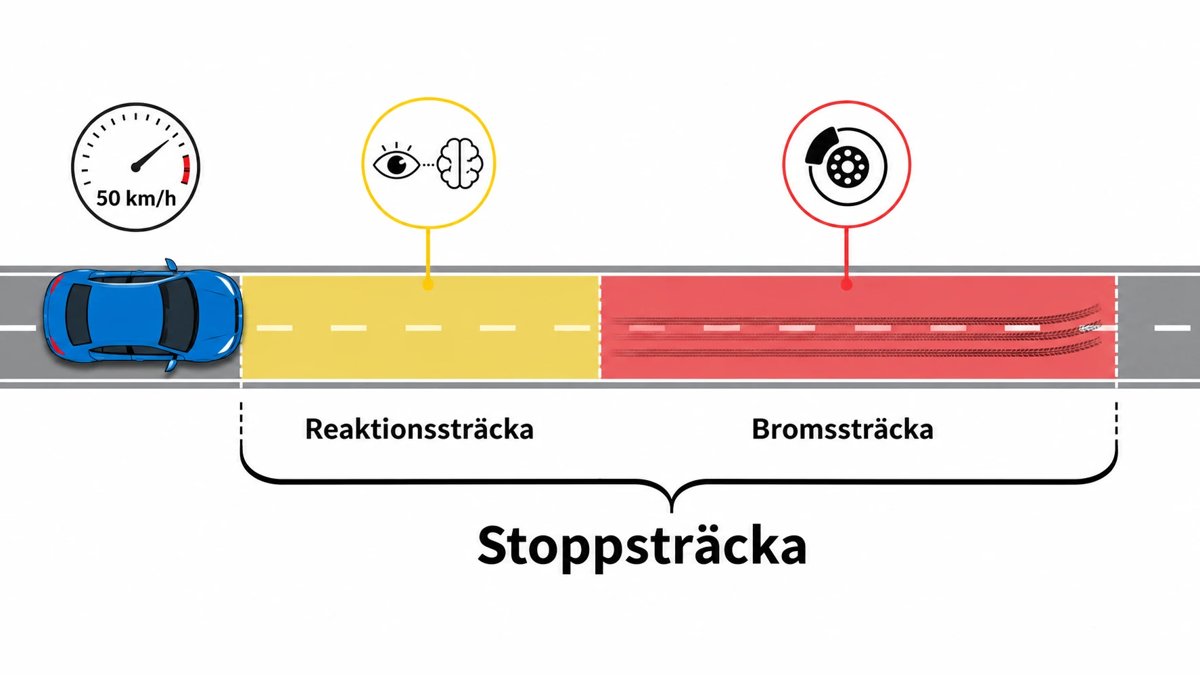
Short answer: Stopping distance is the distance travelled while you react plus the distance travelled while braking. Doubling speed doubles reaction distance and, in the usual simplified model with unchanged grip, gives about four times the braking distance. The model shows a relationship, not a guaranteed real-world stopping point.
Separate reaction distance from braking distance
Stopping distance is the distance travelled while reacting plus the distance travelled while braking. These are separate parts of the same event. Your car continues moving after a hazard becomes visible and before you begin to brake. It then travels farther while the brakes reduce its speed.
Imagine a ball rolling out from between parked cars. First you notice the movement, understand that a child might follow and decide to brake. Only then does braking begin. A question about the distance before braking is asking about a different stage from a question about the distance after braking starts.
Drawing the event can make the terms easier to remember. Mark where the hazard is detected, where braking begins and where the car stops. Label the first section reaction distance and the second braking distance. The full line is stopping distance. Keep this picture in mind when reading a calculation question.
Calculate reaction distance with stated assumptions
A useful calculation starts by converting speed from kilometres per hour to metres per second. Divide by 3.6. Then multiply by the reaction time given in the question. This produces the reaction distance for that example. It does not predict every driver’s response in every real situation.
At 36 km/h, a car travels 10 metres each second. If the example assumes a reaction time of one second, the reaction distance is 10 metres. If the example instead assumes two seconds, it is 20 metres. These are mathematical examples, not recommended reaction times or guaranteed stopping distances.
Keep the assumptions visible when working. Write the speed, the stated time and the unit beside each number. If a question supplies different conditions, use those conditions. A familiar answer from another question can be wrong because the speed or reaction time has changed, even though the wording looks similar.
Understand why higher speed changes the result
For the same reaction time, doubling speed doubles reaction distance. You cover twice as much road during the same delay. Under the usual simplified model with unchanged grip and braking conditions, braking distance increases with the square of speed. Doubling speed therefore gives about four times the braking distance.
This model explains a relationship. It does not provide a fixed real-world stopping point. Road surface, tyres, braking performance and the circumstances of the stop still matter. Avoid learning a distance as though every car at that speed will always stop in exactly that space.
Suppose a practice problem gives a braking distance at one speed and asks about double that speed under the same conditions. Identify that it concerns braking distance, apply the model and keep reaction distance separate. If the question asks for total stopping distance, you need both parts. Read what quantity is requested before doing arithmetic.
Practise with explanations
Körkort Hero offers 1,700+ practice questions in Trafikverket exam style, with explanations, and works fully offline without ads.
Apply the idea to visibility and following space
Stopping-distance knowledge is useful before anything goes wrong. Look at the road you can actually see. A bend, parked van or line of traffic can hide the place where a hazard may appear. Travelling comfortably on a straight section does not guarantee that the next section offers enough visible space.
Following space also gives you time to understand changes ahead. If the vehicle in front slows, you need to notice and respond before relying on the brakes. Watch farther ahead where possible, while continuing to monitor the nearer road. Avoid concentrating only on the rear bumper directly in front.
During a supervised lesson, discuss an ordinary stretch of road before an emergency occurs. Ask which objects limit visibility, where someone could enter the road and what would make you reduce speed. This exercise links the calculation to observation. It is more useful than trying to test a maximum braking distance in normal traffic.
Avoid the mistakes hidden in simple formulas
Before answering a stopping-distance question, check whether the problem concerns reaction, braking or the total. Then check whether the conditions remain the same. A statement about dry-road braking cannot simply be transferred to a slippery surface. Likewise, an assumed reaction time is not a promise about your own performance.
Be careful with units. Kilometres per hour and metres per second describe the same speed in different forms. Multiplying a speed in kilometres per hour directly by a time in seconds will not give the distance in metres. Converting first keeps the calculation clear and makes unreasonable answers easier to notice.
Finish your revision by explaining the event without numbers. What happens while the driver reacts? What happens once braking begins? Which part changes if reaction time increases? Which assumptions are needed for a braking comparison? If you can explain those questions clearly, calculations become a way to apply understanding rather than a sequence of memorised steps.
Frequently asked questions
How do you calculate reaction distance?
Convert speed from kilometres per hour to metres per second by dividing by 3.6, then multiply by the reaction time given. At 36 km/h a car covers 10 metres each second, so one second of reaction means 10 metres.
What happens to stopping distance when speed doubles?
Reaction distance doubles because you cover twice as much road during the same delay. Under the simplified model with unchanged grip and braking conditions, braking distance grows with the square of speed, so about four times.
Is stopping distance the same for every car at the same speed?
No. The simple model explains a relationship only. Road surface, tyres, braking performance and the circumstances of the stop still matter, and an assumed reaction time is not a promise about your own performance.