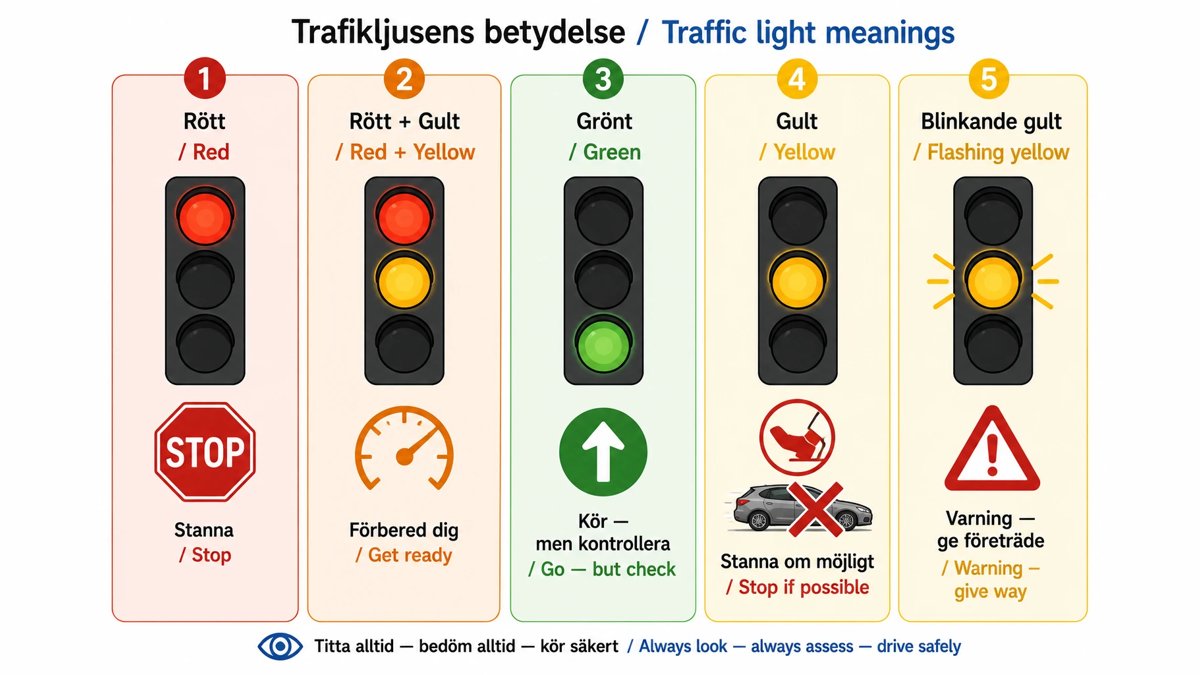
Short answer: In Sweden, a red light means stop before the stop line, or before the signal if there is no line. Red and amber together still mean stop. Green permits you to continue, steady amber means stop unless stopping would be dangerous, and flashing amber calls for special caution.
Stop at red and identify the stop line
A red vehicle signal means stop. Do not pass the stop line. If there is no stop line, do not pass the signal. The place where you stop matters: rolling forward beyond the line can put the vehicle into the space used by other traffic. Read the signal and the road marking together as you approach.
Imagine approaching a junction with a red light and a clearly painted stop line. The road beyond looks empty. That does not turn red into permission to continue. Stop before the line and wait for a signal that applies to your direction. In a practice photograph, find the line before deciding whether the pictured vehicle has stopped correctly.
If there is no painted line, locate the signal itself and stop before passing it. A driver should look ahead early enough to slow smoothly rather than making a rushed final decision. In theory questions, a red light is often simple; the harder part is recognising which signal controls your lane and where the stopping point lies.
Red and amber still mean stop
In Sweden, red and amber can appear together just before green. The combined signal still has the meaning of red. It announces that the change to green is close, but it does not permit you to move past the stop line yet. Wait until the applicable green signal appears and the movement can be made safely.
Picture a learner waiting at the front of a queue. Red and amber illuminate, and the car behind seems ready to move. Do not let that pressure make you cross the line. You can prepare to drive, but the vehicle must remain stopped. Treat the colour combination as information about what is next, not permission for an early start.
This distinction is useful for learners from countries with different signal sequences. If you have previously associated amber with moving, reset that habit for this case. Say the rule aloud during revision: red and amber together still mean stop. Then find a photograph of the same junction showing green and compare the permitted action.
Read green and directional arrows
A green vehicle signal permits a vehicle to continue. It does not remove the need to observe other road users and the path ahead. A green arrow applies to the direction shown by the arrow. A separate signal for another lane or direction may show a different colour at the same time, so match the signal to your intended movement.
For example, a driver waiting to turn may see green for straight traffic but a different signal for the turn. Before moving, identify which lamp or arrow governs the lane and direction you will use. Do not simply follow the vehicle ahead if it is taking another route. The same junction can present different instructions to different movements.
When green appears, look through the junction as well as at the signal. The road beyond might contain queued traffic or a crossing user. A theory image may ask about a conflict that remains after the light changes. Describe the visible road users and your route before concluding that you can move without checking.
Practise with explanations
Körkort Hero offers 1,700+ practice questions in Trafikverket exam style, with explanations, and works fully offline without ads.
Understand the amber exception
A steady amber signal means stop. There is an exception when the signal changes from green to amber after the vehicle has come so close that stopping cannot be done without danger. This is a specific situation, not general permission to accelerate through amber. Judge the distance and your ability to stop safely.
Imagine seeing green far ahead and then amber while there is still room to stop safely before the line. Stop. In a different scenario, the change happens when you are already so close that a safe stop is impossible. The rule allows you to continue in that situation. These two examples differ by the actual stopping situation, not by your preference.
For practice, separate three observations: the light changed from green, your position at that instant, and whether stopping without danger was possible. Do not use an invented fixed distance. Road conditions and the vehicle’s speed can change what a safe stop requires. The theory question should be answered from the conditions it gives.
Treat flashing amber as a separate signal
A flashing amber vehicle signal calls for special caution while passing. It is different from a steady amber signal. Reduce uncertainty by reading the entire junction: where are the crossing routes, which users are approaching and which signs or markings apply? The flashing light does not provide a blanket priority over anyone else.
Picture an approach at a quiet time when the signal is flashing amber. Instead of applying the steady amber stopping rule automatically, check the road layout and cross traffic carefully. A person may still be walking near the crossing. Move only when you have understood the route and can pass safely under the conditions present.
End your revision with a colour sequence in your own words. Red: stop before the line or signal. Red plus amber: still stop. Green: continue when the movement is safe and the signal applies to you. Steady amber: stop unless the specified danger exception applies. Flashing amber: pass with special caution. Then explain each with a road example.
Frequently asked questions
Does red and amber together mean go in Sweden?
No. Red and amber appear together just before green, but the combined signal still has the meaning of red. It announces that green is close, yet you must stay behind the stop line until the green signal appears.
Can I drive through a steady amber light in Sweden?
A steady amber signal means stop. The only exception is when the light changes from green to amber after you are so close that stopping cannot be done without danger. It is not general permission to accelerate through amber.
What does a flashing amber light mean?
A flashing amber vehicle signal calls for special caution while passing and is different from steady amber. It gives no blanket priority, so read the whole junction, cross traffic and any people near the crossing before moving.