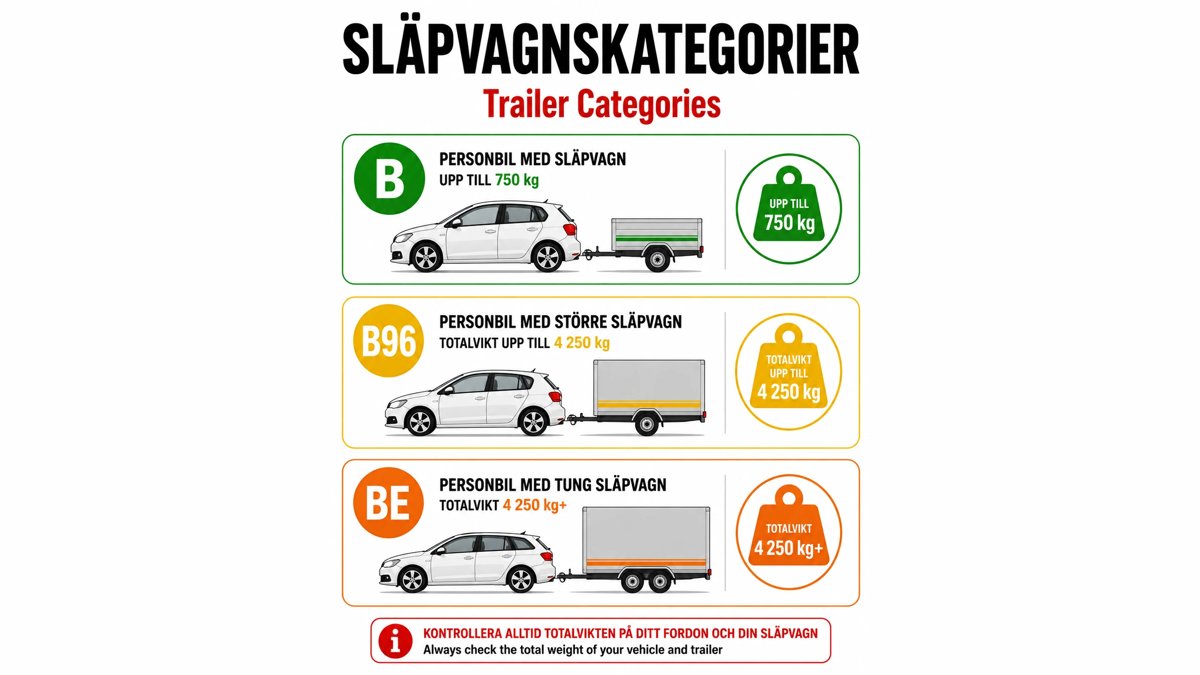
Short answer: Yes, a Swedish class B licence can allow you to tow a trailer, but the weights decide. One ordinary route is a trailer with permitted total weight up to 750 kg. For a heavier trailer, the car’s and trailer’s combined permitted total weights must not exceed 3,500 kg. The car’s own towing limit still applies.
Check the licence and the vehicle separately
A Swedish class B licence can allow you to tow a trailer, but the answer depends on more than the word “trailer.” Check the permitted total weight of the car and trailer, and then check what the specific car may tow. A licence permission cannot raise the vehicle’s technical towing limit.
Start with the car. For the ordinary B category, the car or light lorry has a permitted total weight of no more than 3,500 kg. Then read the trailer’s permitted total weight. These figures appear in vehicle information and are used to decide which licence category the combination requires.
Imagine borrowing a small trailer for a move. The trailer looks light while empty, but appearance is not a reliable guide to its registered weight. Ask for its registration details and check the towing car too. Do this before loading furniture, when changing the plan is still easy.
Use the ordinary B licence weight rules
One ordinary B route is a trailer with permitted total weight no more than 750 kg, provided the towing vehicle is within the B category and the car may tow that trailer. A car with permitted total weight 3,500 kg and a 750 kg trailer can therefore have combined permitted total weights of 4,250 kg under this route.
The other ordinary B route covers a trailer with permitted total weight above 750 kg. In that case, the car’s and trailer’s combined permitted total weights must not exceed 3,500 kg. For example, a 2,200 kg car and a 1,200 kg trailer add to 3,400 kg. You must still check the car’s own towing limits.
Do not assume a heavier trailer automatically requires an extended licence. The combined total is the deciding number for this second route. Equally, a trailer under 750 kg is not automatically suitable for every car. Equipment, coupling and vehicle limits remain part of the check.
Compare total weight with actual weight
Permitted total weight is the registered maximum for a vehicle with its load. Actual weight, often called gross weight, is what the vehicle weighs at a particular moment. An empty trailer can have a low actual weight while its permitted total weight remains above 750 kg. Those two figures answer different questions.
For licence classification, use the permitted total weights specified for the combination. For a car’s technical towing limit, also check the vehicle information and how much the trailer and load actually weigh. A calculation based only on empty weight may appear reassuring while missing the licence rule.
Write the two registered total weights side by side before you do the arithmetic. If the trailer is above 750 kg, add them and compare the result with 3,500 kg for ordinary B. If the trailer is 750 kg or below, apply that route, then check the separate limits for the actual vehicle combination.
Practise with explanations
Körkort Hero offers 1,700+ practice questions in Trafikverket exam style, with explanations, and works fully offline without ads.
Know what extended B changes
Extended B, often called B96, allows a car or light lorry with permitted total weight up to 3,500 kg and a combination whose total permitted weights do not exceed 4,250 kg. The higher combined limit does not remove the car’s towing limits. It changes the licence allowance for the combination.
Consider a car with permitted total weight 2,700 kg and a trailer with permitted total weight 1,400 kg. Their combined total is 4,100 kg. This exceeds the ordinary B combined limit for a trailer over 750 kg but falls within the B96 combined limit, assuming the specific car and trailer can be coupled and loaded legally.
Do not confuse B96 with BE. They are separate licence categories with different rules. If a planned combination exceeds the figures for your licence, check the current Transportstyrelsen guidance before driving. Changing how much cargo you put in the trailer does not change its registered permitted total weight.
Check a real combination before driving
For a real journey, use Transportstyrelsen’s trailer calculator with the registration numbers and your licence category. The calculator helps you check whether a particular car may tow a particular trailer. Verify the result against the vehicle details and any practical limits on load and equipment.
Also think about the trailer after you have established that you may tow it. Secure the load so it cannot shift or fall, and check that your car and trailer are correctly connected. A legal weight calculation does not make an unstable or poorly secured load safe on the road.
In a theory question, underline what kind of weight is given. Is it the permitted total weight of the car, the permitted total weight of the trailer or its actual weight with a load? Then decide which limit the question asks about. This habit prevents a simple arithmetic error from becoming the wrong legal conclusion.
Frequently asked questions
What is the 750 kg trailer rule for a Swedish B licence?
With an ordinary B licence you can tow a trailer whose permitted total weight is no more than 750 kg, provided the towing vehicle is within the B category and the car may tow that trailer. Check the car’s own limits too.
How heavy can a car and trailer be together on a B licence?
If the trailer’s permitted total weight is above 750 kg, the car’s and trailer’s combined permitted total weights must not exceed 3,500 kg. For example, a 2,200 kg car and a 1,200 kg trailer add up to 3,400 kg.
What does extended B (B96) allow in Sweden?
Extended B, often called B96, allows a car or light lorry up to 3,500 kg and a combination whose total permitted weights do not exceed 4,250 kg. It is a separate category from BE and does not remove the car’s towing limits.