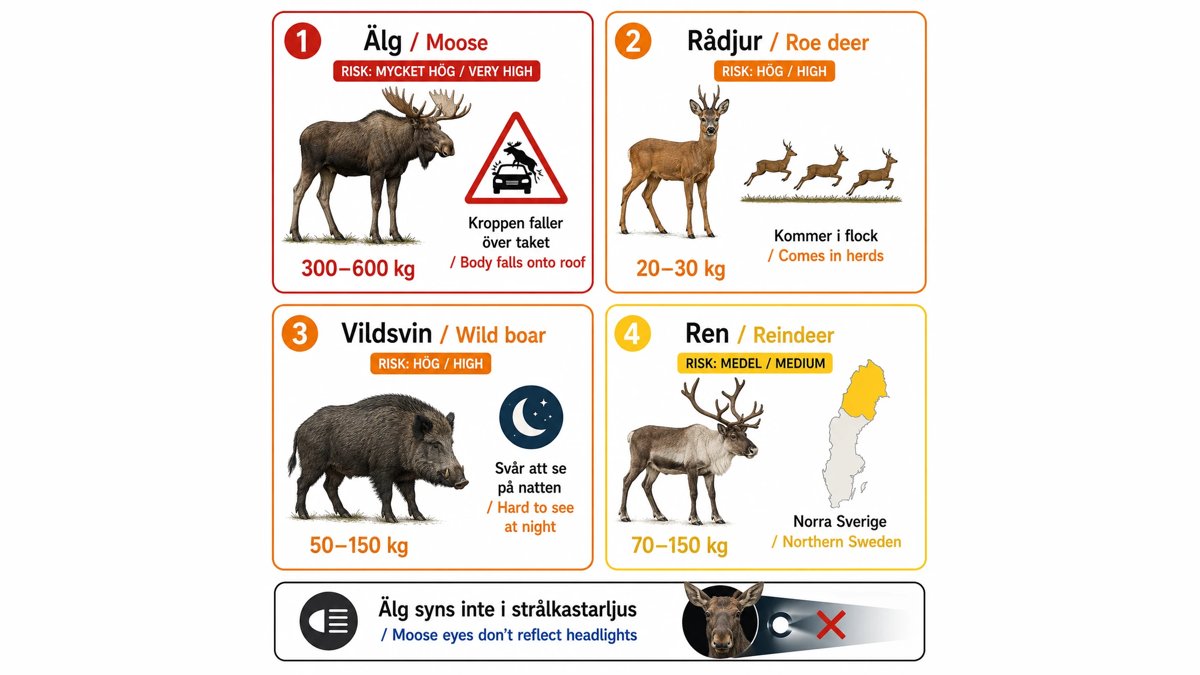
Short answer: After a collision with listed wildlife such as moose, roe deer or wild boar, you must call 112 to inform the police and mark the collision place as soon as possible. Report it even if the animal runs away or seems uninjured. Protect people and keep yourself safe first.
Recognise which collisions must be reported
Sweden has a specific reporting duty after a collision between a motor vehicle and certain animals. The listed wildlife includes moose, deer, roe deer, wild boar, bear, wolf, lynx, wolverine, otter, mouflon and eagle. A collision with a reindeer must also be reported. The exact animal matters, so learn the list from the police rather than assuming every animal has identical rules.
Imagine a roe deer runs from the roadside and strikes the front of your car. It disappears into trees and you see no blood. You still need to report this collision. The reporting duty does not disappear because the animal runs away or seems uninjured.
A theory question may show an animal standing up after impact. Do not answer from its appearance alone. First identify the animal and whether it belongs to the reporting list. Then identify the driver’s duties: mark the location and inform the police. This makes the legal part of the question easier to separate from your immediate safety actions.
Make the road safe before approaching the site
After a collision, protect people first. Bring the vehicle to as safe a stop as the situation allows, watch other traffic and avoid standing in a dangerous place. If someone is hurt, say so when calling for help. Your plan must fit the actual road.
For example, a collision on a narrow rural road at dusk leaves the car near a bend. A person stepping out without looking may be exposed to passing vehicles. Assess where you can stand safely and how to warn approaching traffic. A warning triangle may be needed. Never make marking the animal’s route more important than your own safety.
Do not chase, track or handle an injured wild animal yourself. The police arrange qualified help when needed. An animal that looks calm may still be injured and unpredictable. You can help by describing where it went.
Call 112 and give usable information
For a collision with one of the listed animals, call 112 promptly to inform the police. Have your location ready: road number, nearby place, direction of travel or GPS position if available. Give your details, vehicle information, the animal type and the direction it disappeared. Say whether it remains on or near the road.
Imagine you are unfamiliar with the area and can only see a road sign and a nearby junction. Those landmarks are still useful. Look at the map on your phone if it is safe to do so while stopped. Do not begin driving around to search for the animal before reporting. The location of the collision is the most important starting point.
If you are uncertain whether the animal was injured, report the collision anyway. The police can decide what happens next after receiving the information. In a theory-test scenario, avoid replacing this duty with a call to a friend or an attempt to find the animal. The reporting step belongs to the driver.
Practise with explanations
Körkort Hero offers 1,700+ practice questions in Trafikverket exam style, with explanations, and works fully offline without ads.
Mark the collision point for responders
The driver must mark the collision location as soon as possible. A wildlife marker is useful, but a visible object such as a plastic bag or scarf can be used if you have no marker. Where the animal left the road, mark the side where it disappeared if possible. Choose a method that does not put you in traffic.
For example, you see a wild boar leave through vegetation on the right. Tell the police the direction it went, then mark that side of the road when safe. If you cannot reach the exact place safely, explain the difficulty during the call. A clear description of the road, distance from a landmark and direction is more useful than a risky attempt to place an object.
Marking is not the same as following tracks. It lets trained people find the starting point for any search. It also helps avoid confusion when the damaged car is moved away from the impact site. Keep the object visible and easy to describe. Do not assume that a roadside location will be obvious to someone arriving later.
Study the sequence rather than a slogan
For revision, work through a short sequence: identify the animal, make the scene safe, call 112, give the details and mark the place. The order may change when there are immediate hazards or injuries, but all relevant duties remain. Rehearse what you would say if the animal disappeared, the car could still drive and no passenger appeared injured.
Compare a picture of a moose near a forest road with a picture of a collision already completed. Before impact, the focus is careful observation and speed suited to the risk. After impact, the focus shifts to people, reporting and location. A wildlife warning sign does not tell you whether a collision has been reported or remove your responsibilities afterward.
Keep the official police list available when you study unfamiliar animal names. Do not learn a false rule that every road animal triggers exactly the same procedure. In the situations covered here, even an apparently uninjured animal requires a report.
Frequently asked questions
Do I have to report hitting a roe deer in Sweden?
Yes. A roe deer is on the list of animals that trigger the reporting duty. You still need to report the collision even if the animal runs off, you see no blood, or it seems uninjured.
What should I tell the emergency operator after a wildlife collision?
Call 112 and give your location, such as road number, nearby place or direction of travel, plus your details, vehicle information, the animal type, the direction it disappeared and whether it remains near the road.
How do I mark the place where I hit an animal?
Use a wildlife marker, or a visible object such as a plastic bag or scarf if you have none. Mark the side where the animal left the road if possible, and only if you can do it without entering traffic.